The Hidden Costs of Pre-Trained AI Models
Pre-trained AI models promise quick solutions but can compromise long-term success. Learn how custom AI development protects your IP while delivering unmatched accuracy and efficiency. See why leading companies choose custom development to maintain control over their AI future and create sustainable competitive advantages.

Pre-trained large language models promise plug-and-play solutions for everything from content generation to coding. However, this convenience comes with hidden costs that could impact your long-term success.
The real question isn't whether to use pre-trained models, but how to balance them with custom solutions that truly serve your business objectives and drive Long-Term Success
Innovation Spotlight: While pre-trained models offer quick implementation, custom models trained on your proprietary data and domain expertise can reduce cost per token while delivering unmatched accuracy and efficiency. The key lies in starting with robust open-source foundations and building your unique competitive advantage.
Beyond One-Size-Fits-All Solutions
Pre-trained LLM vs. Custom LLM Solution
Out-of-the-box:
- Pre-trained and ready to deploy.
- Limited to the features and integrations provided.
- Updates and improvements rely on the vendor's timeline.
- Might not be tailored to specific industry needs.
Custom LLM-based:
- Full customization potential.
- Integration with other Azure services and tools.
- Utilizing the power of AI Orchestration for better task management.
- Leveraging Semantic Kernel for advanced understanding and context.
- Potential for continuous improvement and adaptation to specific needs.
When you rely solely on third-party pre-trained LLMs, you surrender control over crucial elements:
- Training process and data selection
- Model customization capabilities
- Performance optimization
- Intellectual property rights
Consider this practical challenge: Ask ChatGPT the same question three days in a row, and you'll likely receive notably different answers. This inconsistency illustrates why depending entirely on pre-trained models can compromise your business outcomes.
The Power of Custom AI: Real-World Impact
Manufacturing Excellence
A leading automotive manufacturer's transformation through custom AI demonstrates the power of specialized solutions. Their approach focused on developing models trained ontheir specific product designs, manufacturing workflows, and historical defect data. The result? A custom solution that achieved what generic models couldn't: real-time defect detection with unprecedented accuracy, leading to significant reductions in scrap rates and warranty costs.
Implementation Insight: Custom models continue learning and adapting as new data arrives, ensuring sustained effectiveness even as manufacturing processes evolve, something generic solutions simply cannot match.
Microsoft ISV Innovation
A retail-focused Microsoft ISV partner exemplifies the transformative power of custom AI in enterprise software. Their tailored solution integrates with Dynamics 365, delivering intelligent customer support using company-specific knowledge. Through comprehensive data analysis and custom model development, they've achieved precise demand forecasting and hyper-personalized marketing capabilities.
Going from Good to Great in LLMs: The Long-Term Commitment
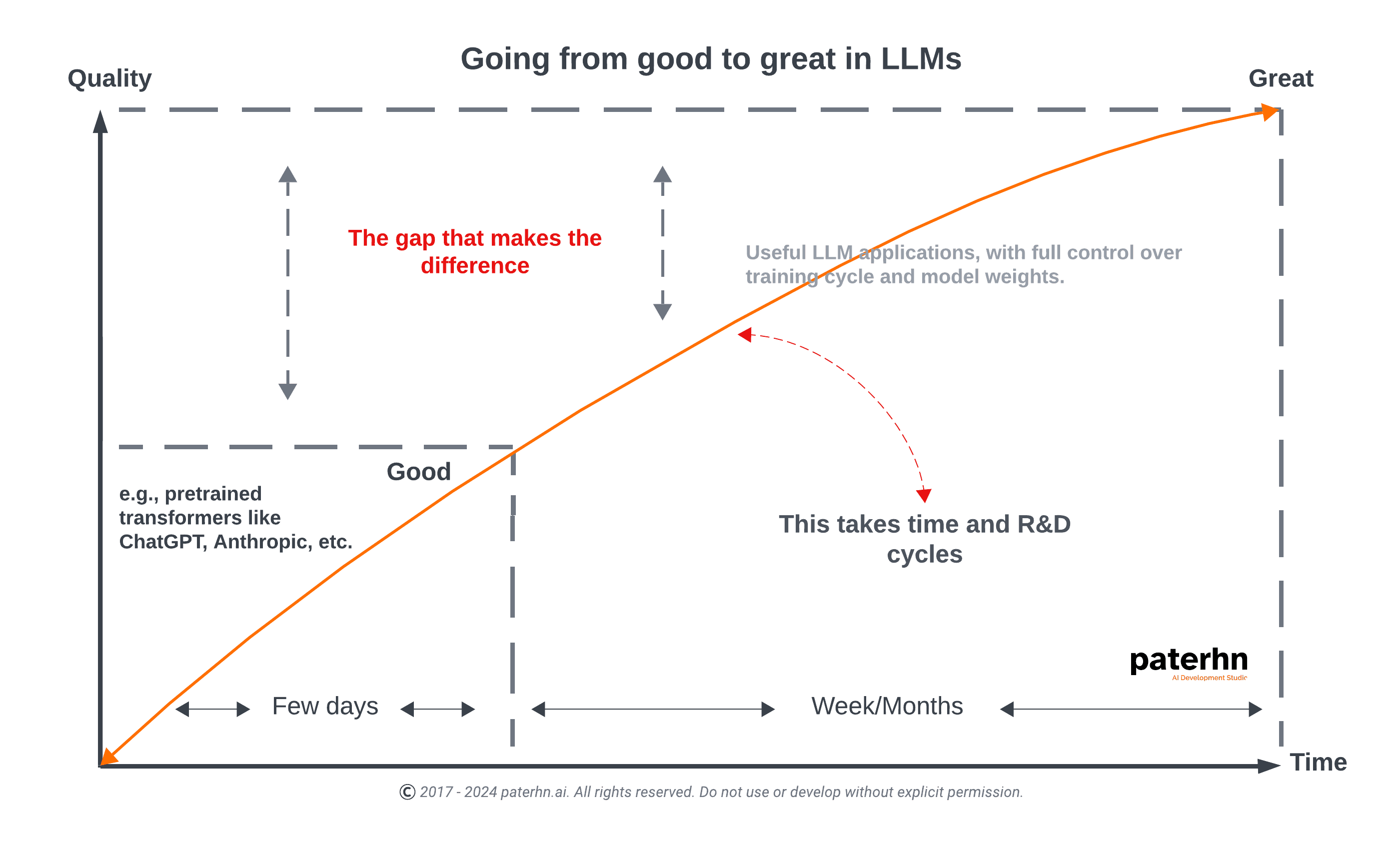
In the world of large language models (LLMs), achieving “good” performance is relatively quick and easy when leveraging pre-trained transformers like ChatGPT and others. However, as this graph illustrates, “great” LLM performance, where models truly deliver tailored, business-specific outcomes, requires significant R&D cycles, time, and continuous refinement.
Graph Explanation:
In the initial stages, getting to "good" with LLMs can take only a few days using pre-trained models. However, moving from "good" to "great" is a steep and ongoing process. It involves custom model development, continuous optimization, and maintaining full control over model weights and training data, elements that are essential for long-term success.
While pre-trained models provide a strong starting point, they come with limitations that can affect long-term scalability and performance. Custom solutions, built with your proprietary data and domain expertise, allow for greater control, precision, and the ability to maintain a competitive edge. This process, as the graph demonstrates, takes time and commitment, but the results, useful LLM applications with unmatched accuracy and full ownership, are worth the investment.
The Strategic Advantage of Custom AI Development
Custom AI development isn't about building for the sake of it, it's about creating a solution tailored to your unique business needs, goals, and data. In today's landscape, where the cost per token and energy efficiency (watt per token) are becoming the new currency, custom solutions offer a significant strategic advantage.
By combining open-source foundations with custom optimizations, you can lower the cost per token while maintaining full control over your intellectual property. This flexibility allows you to adapt to shifting market conditions and technological advancements, ensuring that your AI models are both scalable and cost-effective.
Implementation Insight: One key advantage of custom AI development is the ability to optimize cost and performance through smart model management. Think of it as a “router” that dynamically balances between high-performing custom models and cost-effective open-source LLMs when queries come in from the agent. Imagine you’ve trained a highly specialized model using expensive tokens for maximum accuracy on proprietary data. Now, you can pair it with open-source LLMs to reduce token costs without compromising effectiveness.
Furthermore, owning your models, training data, and processes ensures that you can protect proprietary insights and capitalize on new opportunities. Rather than being locked into one-size-fits-all solutions that can't evolve with your business, custom development gives you the agility to innovate and continuously optimize, delivering both immediate value and long-term, sustainable competitive advantages.
Partnering for Success
While custom AI development requires significant expertise and resources, strategic partnerships can accelerate your journey. At paterhn.AI, we specialize in helping businesses develop custom AI solutions that align with their specific needs and objectives, leveraging state-of-the-art tools and platforms while ensuring best practices throughout the development lifecycle.
Taking Action
The choice between pre-trained and custom AI models isn't binary, it's about finding the right balance for your organization's needs. Custom development represents an investment in your future, transforming AI from a generic tool into a powerful catalyst for innovation and growth.
Don't let your business be constrained by one-size-fits-all solutions. Invest in custom AI that gives you the control, transparency, and competitive edge needed to thrive in today's rapidly evolving market.
Pre-trained models create hidden dependency risks, limiting control over accuracy, data handling and long-term roadmap.
Tailored models trained on proprietary data consistently outperform generic models and become strategic assets rather than commodities.
Owning your model and architecture reduces operational cost, strengthens compliance and unlocks durable competitive advantage.
Frequently asked questions
What are the risks of relying on pre-trained AI models?
Pre-trained models limit control over performance, data governance and roadmap decisions, creating hidden dependencies that weaken long-term competitiveness.
Why do custom AI models perform better?
Custom models trained on proprietary data adapt to domain-specific patterns, delivering higher accuracy, better efficiency and behavior aligned to business needs.
How does owning your model reduce long-term cost?
Model ownership eliminates expensive API usage, enables local optimization and ensures cost-per-inference drops as volume scales.
Related Articles

Code is cheap now. Software isn't.
The barrier to writing code collapsed. The coding agent market exploded from zero to $3 billion in five years. Production teams now deliver in 12 weeks what took 6 months. This article shows how the economics changed, what we've learned shipping code agents into production, and why this moment is not the end of anything. It's a beginning.

Microsoft CEO, Satya Nadella just said the quiet part out loud
Satya Nadella called model sovereignty "the least talked about topic in AI" at WEF26. His point: if you can't embed your firm's knowledge in weights you control, you're leaking enterprise value. Europe loves talking about data residency. But the value moved to the weights. We wrote about this in 2024. Now it's a Davos keynote.