An open-weight model is the graduate, not the school
Open weights release the graduate, not the school. Kimi K3 shows why the difference from open source matters: the license activates at scale, while the architecture keeps the model swappable. Across paterhn deployments, open models carry at least 60% of production agent tasks.

On July 27, Moonshot AI released the full weights of Kimi K3: 2.8 trillion parameters, 1.56 terabytes on Hugging Face, ranked second on the Vals AI index and third on Artificial Analysis. By those public indexes, the strongest open-weight model released to date, free to download and adapt.
For builders it is the most consequential release of the year, and the fear it triggers in boardrooms is mostly misplaced. Free deserves precision, though. The weights carry no license fee. Serving 2.8 trillion parameters takes serious compute, and making that economical is engineering work. What disappeared is the licensing cost and the direct API dependency, not the operating cost. K3 enters our model intake this week, the same evaluation every model gets before it touches client work.
And yet in boardroom after boardroom, the decision is stuck, because two terms are being treated as one thing and they are not. An open-weight model is not an open-source one. The difference decides what you can build, what you owe, and when.
As an engineer, as a physicist, I hold it a solemn obligation: de-complex complexity. Speak it in a language everybody understands. That is the heart of every engineering task. So let me de-complex the two terms paralyzing those boardrooms.
Open source means publishing the recipe: the code, the method, how the thing is made. Open weights means something much narrower: releasing the trained model while much of what produced it stays private. With K3, Moonshot published the architecture and a technical report covering substantial parts of its post-training approach and evaluations. What stays closed is the training data and its mixture, the full recipe, and the next generation.
Think of a school releasing one graduate into the job market while keeping its faculty, its curriculum, and its next class. When a lab open-weights a model, it is not giving away its secrets. It is giving away a graduate and keeping the university.
This is how the most proprietary companies on earth were built. Apple's operating system stands on open-source Unix. Google's Android stands on Linux. Open foundations did not cost them their secrets. Open foundations were the floor their secrets were built on.
Hold the metaphor one step further, because it does real work. You would not refuse to hire a strong graduate because the school kept its curriculum private. You would interview, test, check the references, and read the contract. That is the rest of this article: the market the graduate enters, the contract it arrives with, its references, and the architecture it should work inside.
The market the graduate enters
Three days before the release, twenty-five of the largest technology companies in the world, NVIDIA, Microsoft, Meta, and IBM among them, signed a letter urging Washington to keep AI models open. Companies lobby to keep a layer free when they no longer make their money in it.
The benchmarks say the same thing. A year ago, open models trailed the closed frontier by six to nine months. Today the gap is three to five, and Moonshot reports a 2.5x gain in scaling efficiency over its previous generation, so the compression continues. And Moonshot's own announcement is candid about the ceiling: K3 "still trails the most powerful proprietary models." Open models are now close enough for most work; frontier models stay ahead where the work is hardest. On the open market, K3 serves at $3 per million input tokens. On your own hardware you pay for compute, not for the model.
Even the labs arguing about openness concede the economics. Meta makes the access argument in the Wall Street Journal; Anthropic, publishing its position the day the K3 weights dropped, calls safe open-weight models "a public good" and wants testing, not bans. Opposite business models, same admission: the weights are no longer anyone's moat.
We have been making this argument since 2024, when we wrote about the hidden costs of pre-trained models, and again when Nadella named model sovereignty at Davos: the model is a commodity, and the durable advantage is the loop you build and own on top of it. K3 is that thesis with a download link.
So the news is not that a frontier-class model is free. The news is the terms it travels with.
The contract: what the license actually says
The graduate arrives with a contract. Within a day of the release the weights were everywhere; the license terms were nowhere in the conversation. Their structure is one every buyer of AI will see again this decade: the commercial thresholds are rarely triggered at pilot, and they activate at scale.
Moonshot deliberately avoids the phrase open source. Its own term is open weight, and the Kimi K3 License makes the distinction precise.
Two paths are exempt: internal use, where the model and its outputs stay inside your walls, and access through Moonshot's official products or certified inference partners. Ship it inside a product and cross 100 million monthly active users, or $20 million in monthly revenue, and you must display "Kimi K3" prominently in your user interface. Operate a model-as-a-service business where the aggregate revenue of you and your affiliates exceeds $20 million across any consecutive twelve months, and you must enter a separate agreement with Moonshot before commercial use, on terms the license does not state.
Map the clauses onto your own situation:
Access through Moonshot's official products or certified inference partners is likewise exempt; there the terms you sign are the provider's, not the license's.
Notice what the thresholds are calibrated to. Not your pilot. Not your Proof of Value. Your success. The branding and separate-agreement clauses do not apply to internal evaluation, and the license binds at exactly the point where switching costs the most: when the model sits under real revenue, real users, and real operations. And the binding term is undisclosed: the license requires the agreement without stating what it will cost.
There is nothing scandalous here. Moonshot built something expensive and reserves a commercial relationship with the companies that win with it, while leaving internal enterprise use clean. On its public numbers, K3 is a strong candidate for volume work, and if it clears our intake, we will route real workloads to it. But a clause that activates at scale, on undisclosed terms, is a term sheet on your growth, and it deserves the same review you would give any term sheet. Most teams downloading the weights this week have not done that review.
Moonshot will not draft the last license like this. As the model layer commoditizes, weights-free-terms-later is becoming the revenue model for open-weight labs. Read every "free" model accordingly.
The references: a model has no passport
The other question executives are asking about K3 is different: can we use a Chinese model at all?
Start from what a model actually is. A file. It runs where you run it, reports to no one, and learns nothing you do not feed it. A model has no passport. Its provenance still matters, and it comes in two documents: a license, which defines what you may do with it, and a lineage, which records where it came from and what went into it. Those two documents, not the flag on the lab, are what an engineering organization evaluates.
Jurisdiction still counts, and it is moving fast. Washington is reportedly weighing targeted bans on specific Chinese models rather than a blanket restriction, and has threatened sanctions against Chinese labs over IP theft. The same officials concede that a downloaded file is nearly impossible to recall. The practical consequence: a model in your stack can become a named object in a regulation, and where you operate decides what you can run. For Swiss and EU firms the calculus adds another layer, because your regulators will ask their own questions about provenance, and "we found it on Hugging Face" is not an answer an audit committee accepts.
Hold the hiring frame steady through all of it. The license and the lineage travel with the model the way a contract and a history travel with any hire into a sensitive role. They are a reference check, not a reason to refuse the graduate.
This is why we treat model intake as an engineering discipline, the same way a regulated firm treats hiring for a sensitive role. Before any model touches client work, it gets evaluated on our client's infrastructure, against their baselines and their private evals, with the license, the lineage, and the results recorded as evidence. That discipline costs days. It converts an unknown dependency into a documented component, and it produces the paper trail that answers the regulator's question before it is asked.
The architecture the graduate works inside
License clauses, jurisdiction risk, and next quarter's price list all have the same solution, and it is architectural: the model is a part, never the foundation.
In our production deployments, no workflow addresses a model directly. Work flows through a routing layer that assigns each task to the model that clears the quality bar at the lowest cost. Volume work goes to efficient open-weight models. Hard reasoning goes to frontier models. In production this routing can cut inference costs by 40 to 60 percent against the default of sending everything to the most expensive endpoint. The same layer that routes on cost and capability routes on license posture and provenance: one component knows the terms attached to every model, so a new clause or a ban is a configuration change, never a rebuild.
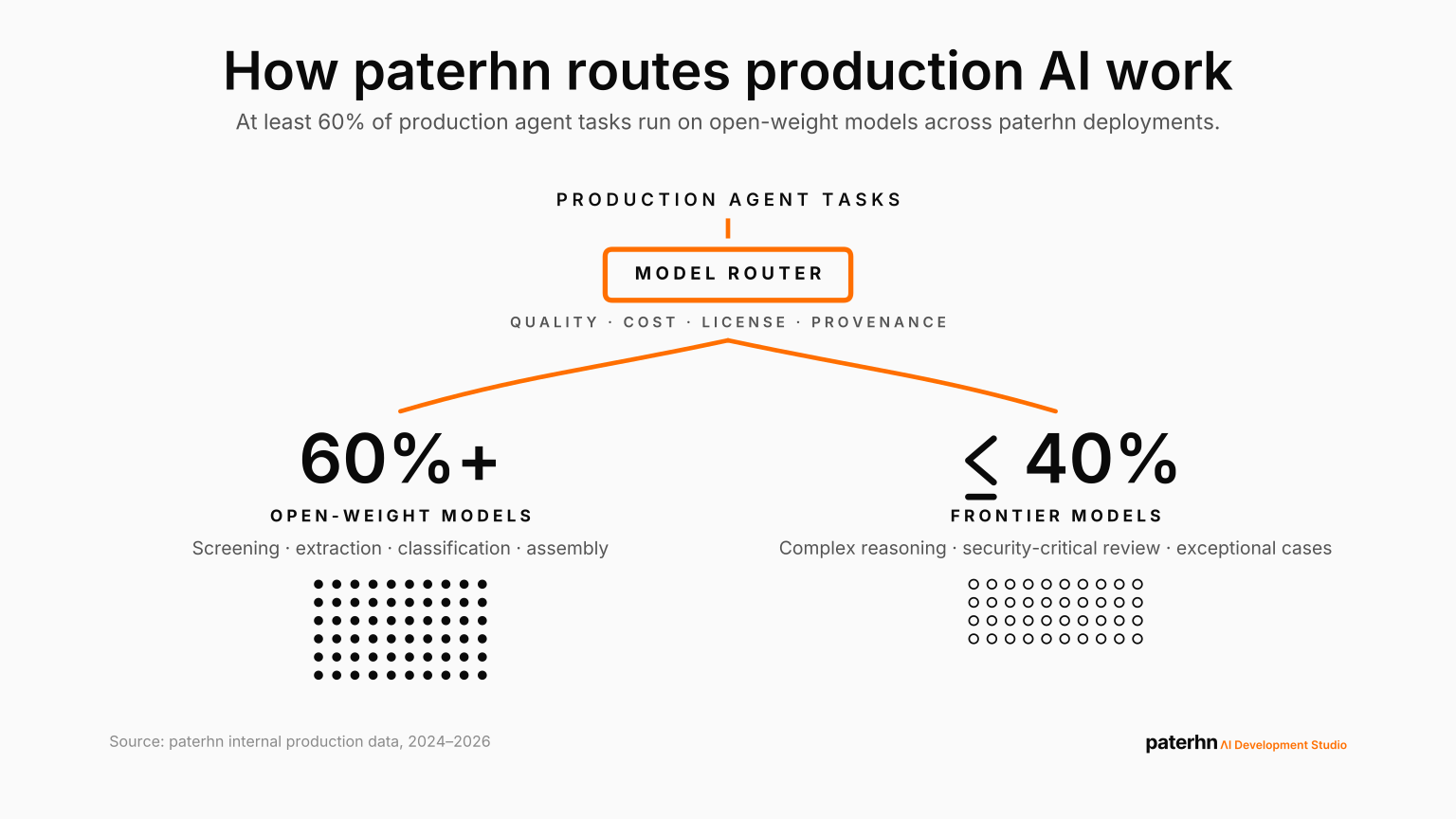
That mix is not a projection. Across our production deployments over the last two years, open models carry at least 60 percent of production agent tasks on average. That share is the recurrent work: the screening, extraction, classification, and assembly that repeats every day and needs no frontier thinking. Most of it runs tuned on the client's own domain, as weights the client owns.
Understand what that 60 percent buys, because the point is not avoiding frontier models. It is affording them. Every token not spent pushing routine work through a premium endpoint is budget freed for the hard questions, where frontier reasoning actually earns its price. That is why a release like K3 is unqualified good news for our clients: a graduate of this caliber just entered the market, and their architecture is built to hire it.
The pattern in production: code review at a fintech software company
One of our clients.
Before: every pull request waited on senior review. First-pass review, test coverage, and documentation trailed delivery, and the automated checks the team added all ran through a frontier API, so the bill grew with every commit.
After: first-pass review, test generation, and documentation updates run on an open model fine-tuned on the client's codebase and review history, on weights the client owns. Security-critical diffs and architectural changes route to a frontier model. Review turnaround on routine diffs fell from hours to minutes. Most agent drafts are accepted with minor edits. Roughly seven in ten agent tasks run on the open model, and the frontier spend concentrates on the diffs where judgment is worth paying for.
One more property of this deployment, and it closes the loop with the license section: the pipeline runs inside the client's infrastructure and its outputs stay internal. Under terms like K3's, the branding and separate-agreement clauses do not apply. The license still enters the intake record, but it does not enter the product UI or require a separate commercial agreement.
"We treat every model as a hire with a contract. The license and lineage are recorded at intake, the evals decide what work it gets, and the routing layer enforces the terms. When a model has to leave, the architecture it worked inside stays."
paterhn production deployment
What stays with the client is everything around the part: the evaluation sets that define what good means in their business, the data pipelines, the workflow logic, the evidence trail, and the accumulated record of decisions. That is the loop that compounds, and on our engagements the client owns all of it outright.
One more step completes the hire. Adapt the graduate: fine-tune it on your own cases, inside your own walls, against your own standards, and the graduate you hired becomes the employee you trained. It runs your processes, speaks your language, and encodes your judgment. Nobody asks where your twenty-year veterans went to university.
One nuance as you do it. The license travels with the weights, including your fine-tuned derivative. Your evals, your pipelines, and your evidence transfer cleanly to the next model. A derivative's license terms do not. That asymmetry is the strongest argument for holding your assets above the model line, where the expertise survives the swap.
The test fits in one sentence: if a better, cheaper, or legally safer model ships next quarter, you drop it in and lose nothing. Pass that test and every license is manageable. Fail it and you have signed terms you have not priced.
The builder test: five questions before any open-weight model touches production
Use these in your next architecture review or vendor conversation. Hesitation on any of them tells you what you are buying.
- What do the terms say at your success scale? Not today's terms. The terms at the users and revenue you are building toward. That is where the K3 clauses live.
- Where is the lineage documented? Origin, training disclosures, known gaps. If nobody can produce it, nobody evaluated it.
- Can the vendor demonstrate the swap? A live demonstration of replacing the model without losing accumulated capability. If the swap has never been performed, it does not exist.
- What is the cost per completed task? Measured on your work, against a routed alternative. Leaderboard position is not a unit economic.
- Who owns the derivative if you fine-tune? And which license travels with it. If the answer is unclear, your improvement curve has a co-owner.
Most companies can run this review across their full model inventory in a week.
Open weights are available. Production still has to be engineered. The laboratories are keeping their universities and releasing graduates, and on the cited public indexes, the strongest one yet has entered the market. Hire it, and train it into your own veteran inside production architecture that you own. When you want that architecture proven on your own workload instead of asserted in a slide, talk to an engineer. Weeks, not years. Your infrastructure, your baselines, every license accounted for.
By the public capability indexes, Kimi K3 is the strongest open-weight model released to date: 2.8 trillion parameters, ranked second and third, free to download and adapt. Free means no license fee; serving 2.8 trillion parameters is real compute and an engineering discipline. The right response is to use it, not fear it.
An open-weight model is the graduate, not the school. Open source publishes the recipe; open weights releases the trained model while the recipe stays largely private. The lab gives away a graduate and keeps the university. Apple built on open Unix, Google on Linux: open foundations were the floor their secrets were built on.
K3 is not open source, and its clauses activate at scale: "Kimi K3" branding above 100M monthly users or $20M monthly revenue, and a separate agreement for model-as-a-service businesses above $20M in aggregate revenue, licensee plus affiliates, in any twelve months, on terms the license does not disclose. Internal use, where the model and its outputs stay inside your walls, is exempt.
A model file has no nationality. It has a license, which defines what you may do, and a lineage, which records where it came from. Both are engineering inputs, and both now carry regulatory weight: Washington is weighing bans on specific Chinese models by name.
The model is a swappable part, never the foundation. Across paterhn deployments in the last two years, open models carry at least 60 percent of production agent tasks: recurrent jobs that need no frontier thinking, on weights the client owns, freeing frontier tokens for the hard questions. Pass the swap test and every license is a configuration entry.
Frequently asked questions
Is Kimi K3 open source?
No, and Moonshot itself avoids the term. Open source publishes the recipe with essentially unrestricted reuse. Kimi K3 is open weight: the trained model is free to download and run, while the Kimi K3 License requires "Kimi K3" branding above 100M monthly users or $20M monthly revenue and a separate commercial agreement for model-as-a-service businesses above $20M in aggregate revenue, licensee plus affiliates, in twelve months. Internal use, where the model and its outputs stay inside your organization, is exempt, as is access through Moonshot's certified inference partners.
Can enterprises legally run Chinese open-weight models?
Today, in most jurisdictions, yes, subject to the license and your sector's rules. The picture is moving: Washington is weighing restrictions on specific models by name, and where you operate decides what you can run. Document the license and lineage at intake, evaluate on your own infrastructure, and architect for the swap, and a future restriction becomes an operations event rather than a crisis.
What is the difference between open weights and open source in AI?
Open source releases the method: code, training approach, and reuse rights. Open weights releases only the trained model, while much of what produced it stays private, and the license can carry commercial conditions. The two get conflated in headlines, and the difference is exactly where the obligations live. The short version: open source is the school; an open-weight model is the graduate.
What does swapping a model actually cost?
In an architecture built for it, days: the routing layer redirects traffic, your evaluation sets re-verify quality, and your data, workflows, and evidence carry over untouched. In a deployment built directly on one model's behavior, months, because prompts, guardrails, and baselines were shaped around a single part. The gap between those two numbers is the real price of any license you sign.
Related Articles

Microsoft CEO, Satya Nadella just said the quiet part out loud
Satya Nadella called model sovereignty "the least talked about topic in AI" at WEF26. His point: if you can't embed your firm's knowledge in weights you control, you're leaking enterprise value. Europe loves talking about data residency. But the value moved to the weights. We wrote about this in 2024. Now it's a Davos keynote.

The frontier model is the easy part. The learning loop is the moat.
The durable advantage is not the frontier model you rent. It is the owned loop between your people and your AI: private evals, your traces, your judgment, your evidence. Compliance is where that thesis gets tested under load. Own the loop, or let the compounding accrue somewhere else.
The Hidden Costs of Pre-Trained AI Models
Pre-trained AI models promise quick solutions but can compromise long-term success. Learn how custom AI development protects your IP while delivering unmatched accuracy and efficiency. See why leading companies choose custom development to maintain control over their AI future and create sustainable competitive advantages.
Code is cheap now. Software isn't.
The barrier to writing code collapsed. The coding agent market exploded from zero to $3 billion in five years. Production teams now deliver in 12 weeks what took 6 months. This article shows how the economics changed, what we've learned shipping code agents into production, and why this moment is not the end of anything. It's a beginning.